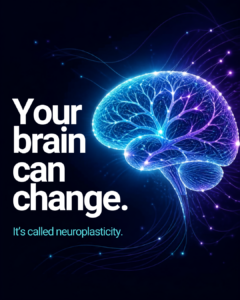
The brain’s ability to adapt and reorganize is known as neuroplasticity.
Ketamine and Neuroplasticity: How the Brain Can Change
The connection between ketamine and neuroplasticity is one of the reasons researchers have become increasingly interested in ketamine’s potential role in mental health treatment. Rather than working primarily through the same neurotransmitter systems targeted by many traditional antidepressants, ketamine affects glutamate signaling and biological processes associated with the brain’s ability to adapt and change.
That ability is known as neuroplasticity.
But what does neuroplasticity actually mean? And what does it have to do with ketamine?
What Is Neuroplasticity?
The brain isn’t a static organ.
Throughout life, it continually responds to experiences, learning, stress, environment, injury, and behavior. Neural connections can strengthen, weaken, and reorganize over time.
This capacity for change is called neuroplasticity.
Think about learning a new skill. At first, the task may require enormous concentration. With repetition, the brain becomes more efficient at performing it. Networks of neurons communicate and adapt as learning takes place.
Neuroplasticity is involved in learning and memory, but researchers are also studying its relationship with mental health.
What Does Neuroplasticity Have to Do With Depression?
Depression is much more complicated than simply having “too little serotonin.”
Scientists now understand that depression can involve changes across multiple neurotransmitter systems, neural circuits, stress-response systems, and biological processes.
Research has also associated chronic stress and depression with changes in the structure and function of certain brain regions and neural connections.
This is where neuroplasticity has become especially interesting.
Rather than looking only at the amount of a particular neurotransmitter, researchers are investigating how effectively brain cells communicate, how neural networks adapt, and whether treatments can influence processes involved in forming and strengthening connections.
How Are Ketamine and Neuroplasticity Connected?
Ketamine primarily interacts with a neurotransmitter system involving glutamate, the brain’s major excitatory neurotransmitter.
One of ketamine’s best-known actions is blocking a type of glutamate receptor called the NMDA receptor. This produces downstream changes in glutamate signaling, including activity involving AMPA receptors.
These effects can activate molecular signaling pathways associated with synaptic plasticity—the ability of connections between neurons to change.
Researchers have also studied ketamine’s relationship with brain-derived neurotrophic factor, commonly called BDNF.
BDNF is a protein involved in the survival, growth, and function of neurons and plays an important role in synaptic plasticity.
The biology is complex, and scientists are still investigating exactly how these processes contribute to ketamine’s clinical effects. But evidence suggests that ketamine can trigger a cascade of cellular events associated with strengthening and forming neural connections.
Does Ketamine “Rewire” the Brain?
You’ll sometimes see ketamine described online as a treatment that “rewires your brain.”
That’s an appealing explanation—but it’s an oversimplification.
Neuroplasticity doesn’t mean the brain is instantly erased and rebuilt. And ketamine doesn’t simply replace negative thoughts with positive ones or permanently create an entirely new brain network during an infusion.
A more accurate way to think about it is that ketamine may temporarily influence biological conditions associated with increased synaptic plasticity.
Researchers are studying whether this period of enhanced plasticity may help explain some of ketamine’s effects and how it might interact with other components of mental health care.
Why Could a Period of Increased Plasticity Matter?
Imagine walking through the same field every day.
Eventually, you create a well-worn path. Taking that route becomes automatic because you’ve traveled it so many times.
Creating another path requires something different. You have to leave the familiar trail and repeatedly travel somewhere new.
The brain is obviously far more complicated than a field, but the analogy helps explain why neuroplasticity matters.
Human brains develop patterns through experiences, behaviors, learning, stress, and countless other influences.
Increasing the brain’s capacity for adaptation doesn’t determine what changes. Experiences and behaviors still matter.
That’s one reason researchers are interested not only in what happens during ketamine administration but also in what happens around and after treatment.
Is Neuroplasticity Unique to Ketamine?
Not at all.
Neuroplasticity is a normal characteristic of the human brain.
Learning, physical activity, sleep, new experiences, environmental enrichment, psychotherapy, and other experiences can influence processes related to neuroplasticity.
Ketamine is interesting because research suggests it may affect some of these processes through a relatively different and rapid biological pathway involving glutamate signaling and synaptic function.
That distinction is important.
Ketamine doesn’t “give” the brain neuroplasticity. Your brain already has that capacity.
Researchers are studying how ketamine may influence mechanisms involved in plasticity and what that could mean for certain psychiatric conditions.
Why Is Ketamine Different From Traditional Antidepressants?
Many traditional antidepressants primarily affect serotonin, norepinephrine, dopamine, or combinations of these neurotransmitter systems.
Ketamine’s primary mechanism is different.
Its effects on glutamate signaling and downstream pathways associated with synaptic plasticity are among the reasons it has become an important area of psychiatric research.
Clinical studies have also demonstrated that ketamine can produce antidepressant effects more rapidly in some patients than conventional antidepressants.
That doesn’t mean ketamine is inherently “better” than traditional medication.
Different treatments have different mechanisms, benefits, limitations, risks, and appropriate uses. A treatment that is helpful for one person may not be appropriate for another.
Neuroplasticity Doesn’t Mean Guaranteed Results
The science surrounding ketamine and neuroplasticity is exciting, but it shouldn’t be turned into a promise.
Ketamine doesn’t guarantee that someone’s depression, PTSD, anxiety, or another condition will improve.
Not everyone responds to treatment, and not everyone is an appropriate candidate for IV ketamine therapy.
Ketamine used for psychiatric conditions is also an off-label use of an FDA-approved medication. Appropriate screening, medical supervision, dosing, and monitoring matter.
Understanding the neuroscience can help patients have better conversations with their healthcare providers—but it doesn’t replace individualized medical evaluation.
Learning More About IV Ketamine Therapy in Lincoln, Nebraska
The emerging science of ketamine and neuroplasticity gives researchers another way to think about mental health treatment: not simply in terms of individual brain chemicals, but in terms of communication, connectivity, and the brain’s remarkable ability to adapt.
Research in this area is continuing, and there is still much scientists are working to understand.
At Elevate Mind & Mood in Lincoln, Nebraska, IV ketamine therapy is provided in a medically supervised environment following an individualized evaluation.
For people who want to understand whether IV ketamine therapy may be appropriate for them, the first step is calling 402-817-4117 to schedule a free consultation!